


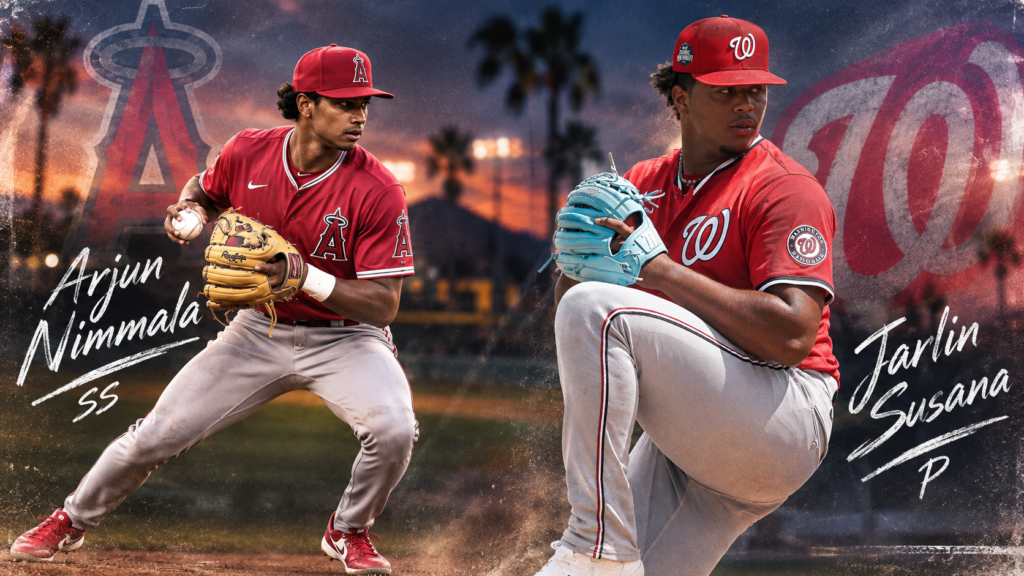
The 2026 Arizona Fall League begins October 3, with the championship scheduled for November 14.
For this watchlist, we’re interested in what those extra games could change. A productive fall would mean more for some players than a few additions to their season totals. It could strengthen a starting pitcher’s chances of remaining in the rotation, give a young hitter’s breakout more credibility, or help an organization make an offseason roster decision.
These seven selections are built around those opportunities. This is not a ranking of the league’s best prospects. Each player has something specific to gain, and each enters with a question that deserves a closer look before we settle on his outlook for 2027.
Statistics reflect Minor League regular-season performance through September 17, 2026. The selections and assessments are Prospect Baseline’s analysis.
How to use the watch points: These are Prospect Baseline’s analytical checkpoints, not official development targets or automatic reasons to change a grade. Regular-season rates are references, not direct measures of AFL difficulty. Pitch-tracking and defensive measurements are included only where usable public data or video are available.
Braylon Payne: Making the Breakout More Convincing
Milwaukee Brewers | Outfielder | Scottsdale Scorpions
Payne has given Milwaukee plenty to like in 2026. His season totals include 28 home runs, 25 stolen bases, and a .910 OPS. The Brewers promoted him from Wisconsin to Biloxi on August 14, his 20th birthday. That combination of production and advancement gives him a substantial season to build on in Arizona.
The strikeouts remain worth watching. Payne struck out 136 times in 467 plate appearances, a 29.1% rate compared with 30.1% in 2025. His power production has improved considerably more than his ability to avoid strikeouts. Both belong in the discussion of his breakout.
MLB Pipeline’s 2026 scouting report provides some context. It credits Payne with taking walks and avoiding pitches outside the zone, but describes a swing that can fall out of sync when he pulls away too quickly. Looking back at 2025, the report identifies missed swings against several pitch types, rather than a problem limited to chasing breaking balls.
What to watch
- Strikeouts and in-zone contact. Use his 29.1% strikeout rate as the full-season reference. Look for fewer strikeouts alongside better contact on swings inside the zone, where tracking is available. A lower strikeout rate without better swing-level contact would need a closer explanation.
- Walk rate after the promotion. He walked 49 times in 467 plate appearances, or 10.5%, but only seven times in 110 Double-A plate appearances, or 6.4%. Watch whether the fall brings more walks without a rise in called strikes on hittable pitches.
- Power without additional swing-and-miss. His 21 doubles, four triples and 28 home runs produced a .275 ISO. Compare fall extra-base production with that reference and, where measured, hard-hit rate. The useful combination would be sustained damage with fewer empty swings, not simply more balls put in play.
- Stolen-base efficiency. His 25 steals came with nine caught stealings, a 73.5% success rate in 34 attempts. Track successful steals and outs together. Better efficiency would support the baserunning case more clearly than a higher stolen-base total by itself.
Jarlin Susana: Keeping the Rotation in View
Washington Nationals | Right-handed pitcher | Salt River Rafters
Susana has struck out 34 hitters in 17⅔ innings this season. Those innings came across seven starts and produced a 5.09 ERA, leaving a limited body of work to evaluate. The strikeouts are encouraging, but the small workload is central to his fall assignment.
His recent injury history explains why. Pipeline’s 2026 report documents the right lat tear that required surgery and ended his 2025 season. His official transaction record shows a rehabilitation assignment to Wilmington beginning August 11, 2026.
The scouting question is familiar. Pipeline identifies his fastball and slider as major strengths, while describing control as a concern for his future as a starter. He walked 15.4% of the hitters he faced at Double-A in 2025. This year, he has issued seven walks alongside those 34 strikeouts.
What to watch
- Walks per nine innings. Seven walks in 17⅔ innings work out to 3.57 BB/9, compared with 5.43 BB/9 across 56⅓ innings in 2025. The fall question is whether the lower walk frequency continues over additional appearances. Keep the very different workloads in view.
- Strikeouts relative to walks. The current starting point is 34 strikeouts against seven walks. In Arizona, calculate strikeout rate and walk rate using batters faced, then track the percentage-point gap, K-BB%. We would want strikeout production to remain strong while walks stay controlled.
- Count management and efficiency. Where pitch logs are complete, track first-pitch strike rate, three-ball counts and pitches per batter faced. Fewer deep counts alongside fewer walks would support improved strike throwing. A lower ERA alone would not answer that question.
- Velocity retention within his workload. Where tracking is available, compare average fastball velocity early and late in each outing, separating fastball types. Record pitch count and innings alongside it. Stable velocity and execution as an outing progresses would be encouraging, but would not establish full-season durability.
Aroon Escobar: An Offseason Roster Decision Ahead
Philadelphia Phillies | Infielder | Surprise Saguaros
MLB identifies Escobar as Rule 5 eligible this offseason. Eligible players left off a club’s 40-man roster can be selected by another organization.
His 2026 offensive line leaves room for a stronger finish. Escobar has hit .230 with a .332 on-base percentage and .679 OPS, adding 12 home runs and 27 stolen bases. It has been a less productive season than his 2025 campaign, when he posted a .774 OPS.
The decline did not come with more strikeouts. Escobar struck out 92 times in 569 plate appearances, a 16.2% rate, down from 18.2% in 2025. His slugging percentage nevertheless fell from .413 to .347. Avoiding strikeouts has not been enough to sustain his previous production.
Pipeline’s 2026 report describes an advanced approach and strong contact skills inside the strike zone. It also points to power that could become more accessible with improved pitch selection. That suggests a useful focus for Arizona: getting more out of the contact he already makes.
What to watch
- Extra-base production. His isolated power fell from .143 in 2025 to .117 in 2026. Watch for an increase in ISO supported by doubles and home runs across multiple games. A higher batting average without more extra-base damage would leave the power question open.
- Contact and walks together. The 2026 reference is a 16.2% strikeout rate and 11.8% walk rate, with 92 strikeouts and 67 walks in 569 plate appearances. A useful offensive gain would add damage while preserving those contact and walk results, rather than trading them away for occasional power.
- Quality and trajectory of contact. Where measured, compare hard-hit rate, average exit velocity and ground-ball rate. More hard contact on line drives and fly balls would help explain an ISO increase. A single maximum exit velocity would not establish that the quality of his typical contact improved.
- Baserunning contribution. His 27 steals and seven caught stealings produce a 79.4% success rate in 34 attempts. Follow both attempts and outs in Arizona. Maintaining or improving that efficiency would support his overall offensive contribution while the extra-base production is evaluated separately.
Eric Bitonti: Getting to the Power More Often
Milwaukee Brewers | Corner infielder | Scottsdale Scorpions
Bitonti’s 25 home runs, .378 on-base percentage, and .885 OPS show why his bat remains interesting. At 20, he has already put together substantial offensive production in 2026. Arizona gives him an opportunity to address the part of his game that makes those results harder to project forward.
He struck out 172 times in 517 plate appearances, a 33.3% rate. Pipeline’s 2026 report describes considerable length in his swing and a tendency to arrive late, including against fastballs in the strike zone. The concern is how often he can make contact and bring his power into play.
There is a defensive opportunity here as well. Bitonti’s fielding record shows 37 appearances at third base in 2026, split between Wisconsin and Biloxi, compared with one in 2025. The increased playing time establishes that he is getting more experience there. It does not tell us, on its own, how well he is handling the position.
What to watch
- A genuine reduction in strikeouts. His strikeout rate was 33.3% in 2026, barely different from 33.5% in 2025. Watch for a clearer reduction accompanied by fewer misses against in-zone fastballs, where pitch-level data exist. Better overall production has not yet come with a substantial strikeout improvement.
- Retaining the walks. He drew 82 walks in 517 plate appearances, a 15.9% rate. Compare that with his fall walk rate and swing decisions. Fewer strikeouts would be more convincing if he still lets difficult pitches go instead of expanding the zone to force contact.
- Keeping the extra-base damage. His 27 doubles, one triple and 25 home runs produced a .245 ISO. Read fall ISO alongside strikeout rate and available hard-hit data. The desired gain is more contact without a large loss of damage when he connects.
- Third-base execution, not just appearances. His 2026 record includes 316⅓ innings and no errors in 90 total chances at third base. Track fall innings, chances and throwing errors, but also review range and difficult plays on video. An error-free record alone does not establish how much ground a defender covers.
Nathan Flewelling: The Work Behind the Plate
Tampa Bay Rays | Catcher | Scottsdale Scorpions
Flewelling arrives with 21 home runs, a .364 on-base percentage, and an .816 OPS in his age-19 season. He also has a Futures Game MVP award on his résumé. His offense has already produced results worth noticing.
The catching deserves equal attention this fall. Pipeline’s 2026 report credits Flewelling with good feet, lateral movement, and blocking ability, along with enough arm strength and accuracy for the position. It also describes a young player who still has considerable development ahead of him. There is a promising defensive foundation, but not a finished product.
What to watch
- The offensive balance. He recorded 132 strikeouts and 71 walks in 486 plate appearances, giving him a 27.2% strikeout rate and 14.6% walk rate, with a .208 ISO. Look for fewer strikeouts without losing the walks or extra-base production.
- Caught-stealing results with the sample attached. Record runners caught, successful steals allowed and total attempts, not just a percentage. Compare the outcomes with video of the throws and pitchers’ deliveries. We would not treat a handful of caught stealings as a complete throwing evaluation.
- Throwing speed and accuracy. Where measured, track median pop time to second base and the number of throws measured. Review throw location separately. The useful question is whether quicker throws are also consistently accurate, not whether one throw produces an impressive time.
- Blocking relative to opportunities. Track passed balls per 100 catching innings and review the underlying plays. Where pitch-level information permits, examine missed blocks relative to blockable pitches. Keep official wild pitches separate, and do not interpret a lower passed-ball total without considering workload and pitch difficulty.
Arjun Nimmala: Building on His Finish With the Angels
Los Angeles Angels | Shortstop | Mesa Solar Sox
The Angels acquired Nimmala from Toronto in the José Soriano trade on August 3. His combined 2026 totals include 16 home runs, a .372 on-base percentage, and an .864 OPS. The change of organization is part of his season, but the details of his offensive progress are more useful to this fall’s evaluation.
Nimmala hit eight home runs and posted a .966 OPS in 27 games with Rocket City. Before the trade, he had an .806 OPS across 33 games with Double-A New Hampshire. The improvement is worth examining, although the timing alone does not establish that the trade caused it.
Pipeline’s 2026 report identifies a specific weakness from his previous season: sliders away. It notes that High-A pitchers exploited that vulnerability in 2025, even as his overall chase rate improved from 2024. Better swing decisions had not eliminated every difficult matchup.
What to watch
- Contact improvement beyond OPS. His strikeout rate was 23.2% with New Hampshire and 23.0% with Rocket City, based on 138 and 126 plate appearances. Those rates were nearly unchanged. Look for fewer misses and strikeouts before describing the stronger finish as a contact breakthrough.
- Whether the walk gains hold. His walk rate increased from 9.4% with New Hampshire to 16.7% with Rocket City. Track walks alongside chase rate, especially on sliders away where pitch locations are available. That would help distinguish improved decisions from a stretch of less competitive pitching.
- Repeatable power production. His ISO rose from .172 with New Hampshire to .317 with Rocket City. Look for continued extra-base damage supported by repeated hard contact, where tracked. Another high OPS would need that context before we project the late-season power pace forward.
- Results against each pitching hand. Separate strikeout rate, walk rate and ISO against left-handers and right-handers, with plate appearances shown for both. This is a check on how broadly the improvement holds up, not a claim that either matchup is already an established weakness.
Demetrio Crisantes: Adding More Damage to the Contact
Arizona Diamondbacks | Second baseman | Salt River Rafters
Crisantes has hit .293 with a .375 on-base percentage, an .854 OPS, and 10 home runs in 2026. At 22, he enters the fall with a productive overall season, though his results at the highest level he has reached tell a more restrained story.
In 46 games with Triple-A Reno, Crisantes hit .277/.337/.410 with three home runs and a .747 OPS. Those numbers need to remain separate from his combined totals when considering how his offense is translating against upper-level pitching.
His contact ability is well documented. Pipeline’s 2026 report cites Synergy’s measurement of a 93% in-zone contact rate in 2025. That season lasted only 34 games before a shoulder injury and surgery ended it. The report identified the response of his power following the injury as something to watch in 2026.
What to watch
- Power against his upper-level reference. His ISO was .186 across all affiliates but .133 in 192 plate appearances with Reno. Keep both references visible. More extra-base damage in Arizona would be encouraging, but would not by itself prove that the power will carry back to Triple-A.
- Preserving the contact advantage. He struck out 30 times in 192 Reno plate appearances, a 15.6% rate, compared with 17.7% across all affiliates. Watch whether added damage comes without a sharp increase in strikeouts. Better contact quality, rather than simply more aggressive swings, is the improvement we would want.
- Walk rate after moving up. He walked 15 times in 192 Reno plate appearances, or 7.8%, compared with 11.9% in 160 plate appearances at Double-A Amarillo. More selective at-bats and a stronger walk rate would add to the offensive case without depending on a higher batting average.
- The quality behind the extra-base hits. Where measured, compare average exit velocity and hard-hit rate, and examine contact on line drives and fly balls separately. An ISO increase supported by more frequent hard contact would tell us more than one long home run or a new maximum exit velocity.
What Would Change Our View?
The strongest case for a higher evaluation would combine an improved result with evidence explaining it. A lower strikeout rate supported by better in-zone contact is more useful to this watchlist than a higher batting average alone. More extra-base damage is more convincing when it comes with repeated hard contact.
The size of the sample still matters. In a fixed sample of 60 plate appearances, one additional strikeout changes the rate by 1.7 percentage points. In 10 innings, one additional earned run changes ERA by 0.90. Small differences should not be presented as settled changes in ability.
Keep AFL and regular-season results separate, show the relevant plate appearances, batters faced or tracked opportunities, and account for the level of competition. Where the measurements are missing or the sample is thin, leave the question open. Any change to a 2027 outlook should have a reason that survives a closer look at the numbers.
Statistical notes
K% and BB% divide strikeouts and walks by plate appearances for hitters, or batters faced for pitchers. K-BB% is the percentage-point difference between those rates. ISO is extra bases per at-bat: (doubles + 2 × triples + 3 × home runs) ÷ at-bats.
Hard-hit rate is the share of measured batted balls hit at 95 mph or harder. Whiff rate measures misses per swing; in-zone contact rate measures contact per swing at pitches inside the strike zone. Tracking comparisons should use consistent definitions and disclose how many pitches or batted balls were measured.
Rates are calculated from counting totals and rounded to one decimal place for percentages, two for per-nine rates and three for ISO. ISO uses the underlying hit totals rather than subtracting rounded AVG from rounded SLG. Innings notation is converted to outs before calculation. Historical figures are regular-season statistics through September 17, 2026.