

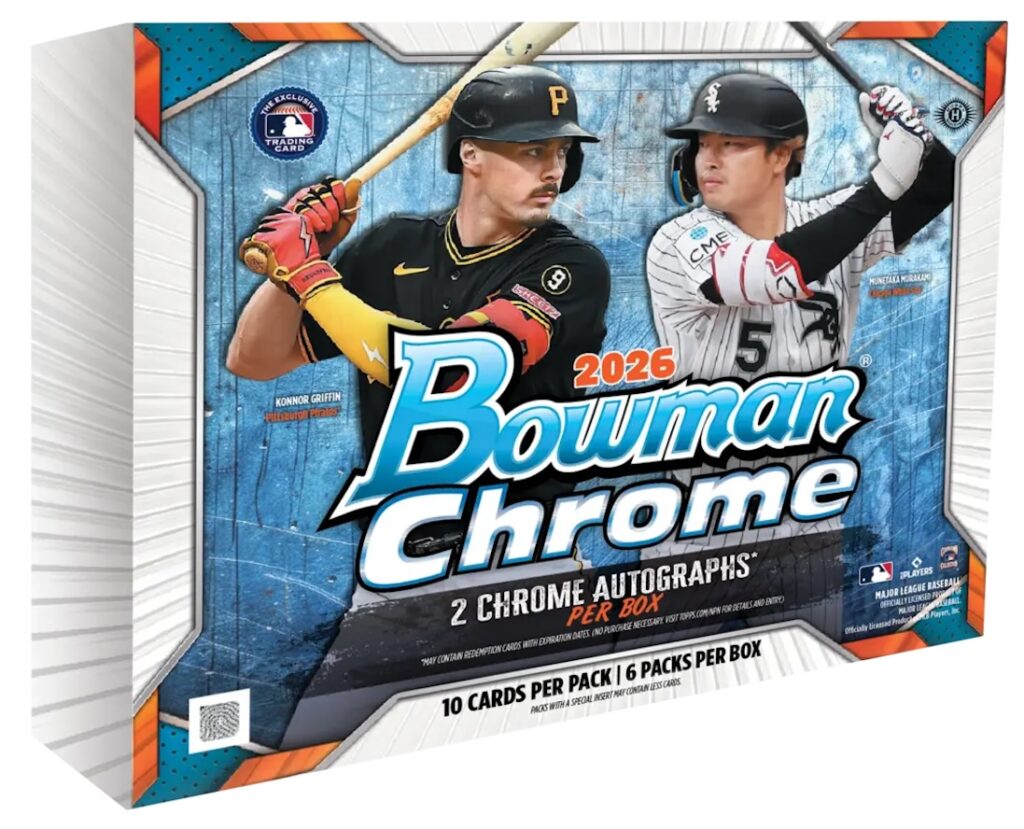
The 2026 Bowman Chrome prospect checklist is loaded with exactly the type of players that make Bowman Chrome interesting: highly regarded international signings, teenage breakouts, lower-level players putting up enormous numbers, more advanced prospects already proving themselves against full-season competition, and dozens of names most collectors have barely had time to learn.
That also makes this a difficult checklist to evaluate.
A strong Dominican Summer League stat line does not carry the same certainty as success in Double-A. A 17-year-old shortstop with enormous physical projection presents a very different risk profile than a 21-year-old pitcher already missing bats in the upper minors. And the biggest name entering a season is not necessarily the player whose underlying performance looks best several months later.
That is where Prospect Baseline comes in.
Rather than treating every player equally, this guide uses the Prospect Baseline model to work through the entire 2026 Bowman Chrome checklist. Players near the top receive the deepest evaluation, while the further we move down the board, the focus shifts toward identifying the single most important reason a player deserves attention.
The Prospect Baseline numbers used here reflect the August 11, 2026 model run. Because Prospect Baseline is a daily model, rankings and ranges can move as performance, level, sample size, confidence and roster status change.
The three numbers accompanying each player are the model’s Low / Median / High outcome range, followed by the current Performance score.
This is not a card-price ranking. It is a prospect ranking.
And that distinction creates some very interesting results.
THE HEADLINERS — RANKS 1–12
1. Christian Zazueta — RHP
Prospect Baseline: 77 Low | 82 Median | 89 High | 76 Performance
Christian Zazueta sits at the top of the 2026 Bowman Chrome board for a fairly simple reason: there are very few obvious weaknesses in the current statistical and developmental case.
At 21 years old, Zazueta has already reached Double-A and has struck out 113 batters in 78.2 innings this season while carrying a 3.66 ERA and 0.94 WHIP. That combination of level, age, run prevention and swing-and-miss ability gives the model substantially more evidence to work with than it has for most of the teenage players farther down this checklist.
His arsenal provides more substance behind those strikeout totals. Zazueta works with a fastball generally operating in the low-to-mid 90s and capable of reaching the upper 90s, complemented by an advanced changeup and a mid-80s slider. The changeup may be the most important piece because it gives him a legitimate weapon beyond the fastball rather than leaving his future dependent on velocity alone.
There is also a developmental story here. Zazueta was originally signed by the Yankees before being acquired by the Dodgers in the 2024 Caleb Ferguson trade. His results have improved significantly as his command and ability to use the entire arsenal have developed.
The model’s 77 floor is particularly notable. Zazueta does not have the widest range on this checklist, but that is part of the appeal. Prospect Baseline is seeing both upside and an unusually strong foundation.
The primary question is ultimately role. Pitching prospects carry inherent volatility, and Zazueta was placed on the Development List on August 8. But based strictly on what has already happened on the field and the quality of the arsenal supporting it, this is no longer merely an interesting low-level arm.
Prospect Baseline takeaway: Zazueta currently offers the strongest combination of performance, advancement and projected outcome in the entire 2026 Bowman Chrome class.
2. Luis Hernández — SS
75 Low | 80 Median | 87 High | 70 Performance
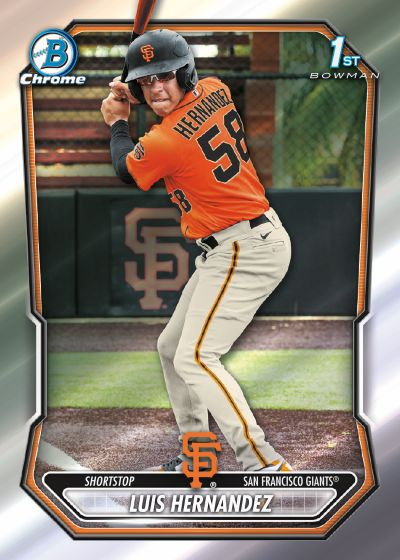
If Zazueta represents the more established case at the top, Luis Hernández represents the opposite side of the prospect spectrum: extraordinary youth combined with an unusually advanced offensive and defensive foundation.
Hernández is just 17 years old and has already been moved into Single-A after beginning the year in the Arizona Complex League. Across his 2026 minor-league season, he has hit .275 with eight home runs, 51 RBI and an .846 OPS, an impressive level of production for a player his age.
The scouting foundation is even more compelling.
Hernández shows advanced pitch recognition, quality bat-to-ball ability and enough bat speed for evaluators to project significantly more power as he matures. His defensive profile gives the bat even more value: he has the actions and arm strength to remain at shortstop rather than being a teenage offensive prospect already facing an inevitable move down the defensive spectrum.
There is a reason the model can assign an 80 median and 87 high despite a Performance score sitting at 70.
Prospect Baseline isn’t evaluating Hernández solely on what he has already produced. Age relative to competition, position, developmental runway and the quality of the underlying prospect profile all matter.
That makes him one of the most traditional premium Bowman Chrome chases in the set: young, athletic, at a premium position and possessing a plausible path toward impact offensive production.
The risk is equally obvious. He is still 17. The distance between Single-A and the major leagues is enormous, and physical development can reshape both offensive and defensive projections.
Prospect Baseline takeaway: If you prefer position-player upside over the relative certainty Zazueta currently provides, Hernández has the strongest argument for being the most desirable prospect in the checklist.
3. Enddy Azocar — CF
66 Low | 71 Median | 77 High | 62 Performance
Enddy Azocar might have one of the most important combinations on the board: significant production and success while climbing the developmental ladder.
At 19, Azocar has already advanced through Single-A and into High-A. Across the 2026 season he has produced a .291 average, 19 home runs, 71 RBI, 11 stolen bases and an .893 OPS.
The power development is particularly encouraging. Added strength has helped Azocar generate better exit velocities, and his bat speed gives him a legitimate path toward above-average home-run production if he continues improving his ability to handle secondary pitches and consistently elevate the baseball.
There is some defensive uncertainty. He has played extensively in center field, but his long-term home could eventually be right field. That raises the offensive standard he would need to meet, although his arm and developing power give him tools that fit that profile.
There is also a very recent organizational change worth knowing. The Bowman Chrome/Prospect Baseline checklist reflects his Boston organization context, but Azocar was moved to Baltimore at the August 3 trade deadline.
The model is slightly more reserved than his headline 2026 numbers might initially suggest. That isn’t necessarily negative. It reflects the difference between a breakout statistical season and projecting exactly how much of that production survives against more advanced pitching.
Prospect Baseline takeaway: Azocar has moved beyond pure projection. He’s already answering important developmental questions while still being young for the levels he has reached.
4. Francisco Renteria — OF
63 Low | 69 Median | 76 High | 72 Performance
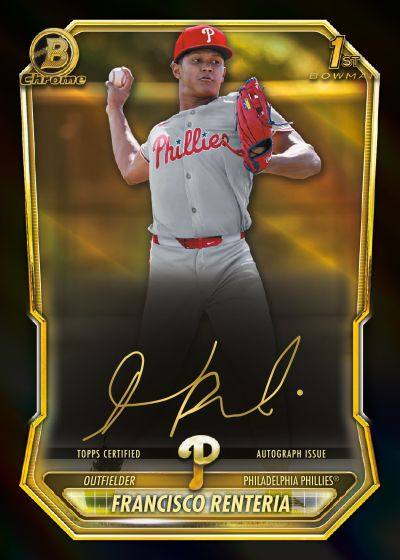
If this ranking were based exclusively on statistical dominance, Francisco Renteria would have an argument for the top spot.
The 17-year-old Phillies outfielder has hit .366 with a .447 OBP, nine home runs, 47 RBI, 20 stolen bases and a 1.087 OPS in his professional debut.
Those are enormous numbers.
They are also Dominican Summer League numbers, and that distinction matters.
Renteria is one of the clearest examples of why the Prospect Baseline range is useful. His 72 Performance score actually exceeds his 69 median, showing how strongly the model recognizes what he has done. At the same time, the 63–76 range maintains some restraint because practically his entire professional evaluation is still being formed.
At 6-foot-3 and already over 200 pounds, Renteria has an unusually developed physical frame for a 17-year-old. Pairing that size with nine home runs and 20 stolen bases makes the early profile especially interesting because there is already evidence of both impact and athleticism.
The next test is important. Dominating the DSL creates attention. Translating it into complex-league and then full-season production changes a player’s prospect status entirely.
Prospect Baseline takeaway: Few players in this set have done more to improve their prospect case during 2026. Renteria is one of the checklist’s highest-upside performance bets.
5. Angel Nuñez — OF
54 Low | 59 Median | 65 High | 63 Performance
Angel Nuñez has quietly assembled one of the more complete statistical profiles among the 17-year-olds in this checklist.
The Reds outfielder is hitting .293 with a .435 OBP and .902 OPS, but the number that really stands out is 22 stolen bases in only 150 at-bats. He has also hit four home runs and scored 41 times.
The obvious carrying trait right now is athleticism. Nuñez is listed at 5-foot-10 and 160 pounds, so this isn’t a prospect whose value is being driven by unusual physical maturity against DSL competition.
That creates both upside and uncertainty.
His speed is already translating into games, the on-base performance has been excellent and there is plenty of physical development still ahead. Conversely, projecting future impact power from his present frame would be premature.
The relationship between the model’s 59 median and 63 Performance score is worth watching. Production is beginning to pull the profile upward.
Prospect Baseline takeaway: Nuñez is a speed-and-on-base prospect whose stock could rise sharply if additional offensive impact emerges as he physically matures.
6. Joniel Hernandez — SS
54 Low | 59 Median | 66 High | 64 Performance
Joniel Hernandez has already given evaluators quite a bit to work with during his debut.
He has hit .307 with a .434 OBP and .945 OPS, adding five home runs and eight stolen bases. More importantly, he is doing it as a 17-year-old shortstop.
Like several players near the top of this list, Hernandez’s current Performance score of 64 is running ahead of his 59 median. That is exactly the profile we want to identify in a prospect product: a young player beginning to generate evidence faster than the longer-term projection has fully adjusted.
There is also a current-team wrinkle. The checklist still reflects his San Diego context, but Hernandez was traded to the Giants organization on August 3.
The premium position helps. A teenage shortstop does not need to develop into a 30-home-run hitter to become a meaningful prospect if the player can remain at the position and provide offensive value across multiple categories.
Prospect Baseline takeaway: Hernandez has one of the stronger combinations of age, position and early offensive performance outside the absolute top of the board.
7. Santiago Solarte — SS
55 Low | 60 Median | 68 High | 64 Performance
Santiago Solarte might be the player whose raw stat line causes the biggest double take.
The 17-year-old Marlins shortstop is listed at 6-foot-5, 200 pounds and has produced a .319 average, .434 OBP, 1.017 OPS, 10 home runs and 39 stolen bases.
Yes, 39 stolen bases.
That is an unusual athletic profile for a player his size.
So why isn’t Solarte ranked even higher?
Because this is precisely the type of player where developmental uncertainty matters. He has not yet faced full-season pitching, and a 6-foot-5 teenage shortstop presents obvious questions about where he will ultimately fit defensively as his body continues to mature.
But those questions should not overshadow what makes the profile exciting. Very few prospects combine this type of frame, current power and running production at 17.
His Performance score of 64 is already ahead of the 60 median.
Prospect Baseline takeaway: Solarte may carry one of the most visually intriguing upside profiles on the entire checklist. The next level will tell us considerably more.
8. Jaider Suárez — SS
55 Low | 60 Median | 67 High | 67 Performance
Jaider Suárez is another player forcing his way into the conversation through production.
The 17-year-old Royals shortstop is hitting .374 with a .497 OBP and 1.050 OPS, and he has stolen 26 bases while striking only two home runs.
That immediately gives the profile a different shape from Solarte’s.
Suárez’s present value is much more heavily concentrated around reaching base, making contact and turning athleticism into baserunning value. Whether enough power develops will ultimately determine how large the offensive ceiling becomes.
The important model signal is unmistakable: 67 Performance versus a 60 median.
In other words, his 2026 season is outperforming the longer-range baseline by a meaningful margin.
DSL performance always demands context, but this is exactly the type of profile worth tracking aggressively as the player advances.
Prospect Baseline takeaway: Suárez is one of the strongest pure performance risers on the Chrome checklist.
9. Samil Serrano — OF
54 Low | 59 Median | 66 High | 65 Performance
Samil Serrano gives Washington another young outfielder worth monitoring closely.
The 17-year-old has hit .300 with a .418 OBP and .941 OPS, adding four home runs and 11 stolen bases.
Nothing about that line is dependent upon one extreme statistic. He is reaching base, showing some power, running and maintaining a strong overall offensive line.
At 6-foot-3 and 173 pounds, there is also considerable room for physical development.
That’s what makes Serrano interesting. The present production already creates a legitimate prospect foundation without requiring the assumption that his body is finished developing.
His 65 Performance score again sits above his 59 median.
Prospect Baseline takeaway: Serrano is not the loudest name on the checklist, but the combination of frame, age and balanced production gives him more upside than the ranking alone might suggest.
10. Angeibel Gomez — OF
61 Low | 69 Median | 79 High | 75 Performance
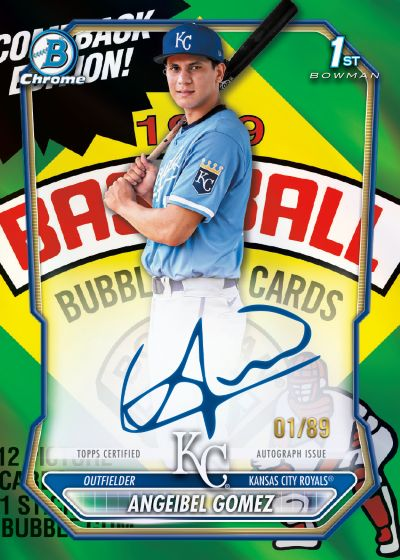
Angeibel Gomez is the first player in this article where the ranking number almost does him a disservice.
Look past the “#10.”
His actual model profile — 61 / 69 / 79 with a 75 Performance score — is better than several players ranked ahead of him.
Then look at the production.
At 17, Gomez has hit .356 with a .467 OBP and 1.104 OPS, producing eight home runs and 13 stolen bases in 135 at-bats.
That is one of the strongest offensive performances anywhere on the checklist.
He also has enough size at 6-foot-2 to create a legitimate physical-development argument rather than simply projecting a player who is already maxed out.
The issue, again, is level. Gomez has not yet been asked to prove any of this against full-season competition. Prospect development is filled with DSL stars whose trajectories changed dramatically once pitching quality improved.
But there is a difference between acknowledging that risk and ignoring performance.
Gomez has earned attention.
Prospect Baseline takeaway: If you’re looking for a player whose ordinal ranking understates how interesting the underlying model profile actually is, Gomez may be the best example in the entire set.
11. Sebastian Dos Santos — SS
63 Low | 70 Median | 80 High | 71 Performance
Sebastian Dos Santos is one of the most unusual statistical profiles near the top of this board.
The 18-year-old switch-hitting shortstop has a modest .227 batting average, but he has still produced a .379 OBP and .801 OPS while hitting 10 home runs and stealing 24 bases.
That is exactly why batting average alone can be misleading when evaluating young hitters.
Dos Santos is creating value through walks, power and speed despite not collecting hits at an especially high rate.
Even more importantly, he is doing it in Single-A rather than the DSL.
Prospect Baseline sees the combination as one of the strongest in the class: 70 median, 80 high and 71 Performance.
The obvious development point is contact consistency. If the batting average rises while he retains the ability to reach base and impact the baseball, the profile becomes dramatically more dangerous.
Prospect Baseline takeaway: Dos Santos has already reached a level where his performance means more, and the combination of power, patience, speed and premium defense gives him legitimate breakout potential.
12. Luis Cova — OF
54 Low | 61 Median | 70 High | 61 Performance
Luis Cova’s 2026 line is not overwhelming at first glance: .237 average, five home runs and a .744 OPS.
But there are two numbers worth paying attention to.
A .370 OBP and 28 stolen bases.
Cova has also reached Single-A and is only 19, giving the model more developmental evidence than it has for most of the DSL-heavy portion of this checklist.
His career numbers show that speed is not a one-season fluke; baserunning has consistently been an important part of his offensive profile.
The question is whether the hit tool and impact quality develop enough to complement it. Speed alone creates a narrower major-league path than speed attached to consistent on-base ability and additional power.
Prospect Baseline’s 61 median matches his current 61 Performance score almost perfectly.
Prospect Baseline takeaway: Cova currently looks less like a hype-driven breakout and more like a balanced developmental prospect whose speed gives him an additional path to value.
HIGH-UPSIDE TARGETS — RANKS 13–30
13. Talon Haley — LHP
51 Low | 56 Median | 61 High | 55 Performance
Haley’s surface pitching line — a 4.95 ERA and 1.43 WHIP — is not dominant, but the strikeouts demand attention: 101 in 72.2 innings. The 20-year-old left-hander is already showing the ability to miss bats at Single-A.
That creates a straightforward development question: can the efficiency and baserunner prevention catch up to the swing-and-miss ability?
Takeaway: There is more pitching upside here than the ERA alone suggests, but also enough current volatility to keep the model restrained.
14. Juan Rijo — OF
48 | 54 | 60 | Performance 58
Rijo has hit .306 with a .429 OBP and .894 OPS as a 17-year-old in the DSL. The three home runs and eight steals do not jump off the page individually, but the overall offensive line is strong.
His Performance score has already moved ahead of the median.
Takeaway: A balanced teenage offensive profile that deserves another look as soon as he is tested at a higher level.
15. Cleiner Ramirez — OF
47 | 53 | 60 | Performance 54
Ramirez has hit only .241, but seven home runs and 18 stolen bases give the profile more substance than the batting average suggests. He has also produced a .357 OBP and .819 OPS at 17.
Takeaway: Power-speed potential makes Ramirez interesting, but continued improvement in overall offensive consistency will determine whether he separates from the large group of DSL outfielders behind the headliners.
16. Sean Paul Liñan — RHP
48 | 52 | 57 | Performance 47
Liñan is already in High-A, which gives his profile a different degree of developmental maturity than many players surrounding him. The current 47 Performance score is below the 52 median, however.
Takeaway: An advanced-level arm whose future movement on this list will depend more on performance improvement than projection.
17. Jeyson Horton — SS
46 | 52 | 58 | Performance 55
Another 17-year-old DSL shortstop, Horton is currently performing slightly ahead of his baseline.
Takeaway: There is an early positive signal here, but not yet enough separation to move him into the upper tier of teenage shortstop targets.
18. Alex Lodise — SS
50 | 59 | 68 | Performance 51
Lodise is one of the more interesting examples of projection outrunning current production. Prospect Baseline gives him a 59 median and 68 high, but the Performance score sits at 51.
Takeaway: The model still sees more than the current stat signal is delivering. That makes future performance especially important.
19. Sebastian Blanco — SS
46 | 51 | 57 | Performance 51
Blanco’s Performance and median are currently identical.
Takeaway: A true wait-and-see profile. There is enough baseline value to stay on the radar, but no major model-performance divergence yet.
20. Diego Frontado — SS
52 | 60 | 70 | Performance 67
Frontado is where the board gets particularly interesting again.
A 67 Performance score against a 60 median is significant, and the model still allows for a 70 high outcome.
Takeaway: One of the better sleeper profiles in the top 25. The production is beginning to make a case for a higher ranking, with DSL uncertainty being the primary brake.
21. Juan Torres — 2B
51 | 60 | 72 | Performance 68
Torres owns one of the wider and more intriguing ranges in this tier. A 72 high combined with a 68 Performance score suggests considerably more upside than a #21 label might imply.
Takeaway: An under-the-radar model favorite whose performance is already pressuring the baseline upward.
22. Brandon Butterworth — SS
50 | 58 | 71 | Performance 62
Butterworth stands out because he is already in Double-A. The 71 high gives the model room for meaningful upside while the 62 Performance score is already ahead of the median.
Takeaway: Greater proximity makes Butterworth one of the more interesting non-teenage names in this part of the checklist.
23. Elian Rosario — SS
46 | 51 | 58 | Performance 54
Rosario’s Performance score is modestly above baseline, creating an early positive signal without yet producing a major breakout case.
Takeaway: Worth monitoring, but the model needs more evidence before widening the upside materially.
24. Manuel Bolivar — C
51 | 59 | 70 | Performance 65
Young catchers present additional developmental challenges, which makes a 65 Performance score from a DSL catcher particularly interesting.
Takeaway: One of the stronger position-relative sleepers in this section. Catching development creates risk, but also scarcity if the bat continues to progress.
25. Wellington Aracena — RHP
44 | 49 | 55 | Performance 45
Aracena has reached High-A but currently sits below his median Performance expectation.
Takeaway: The level provides useful evidence; the performance simply needs to improve before the model can become more aggressive.
26. Louis Andujar — SS
54 | 64 | 79 | Performance 67
Forget the ranking for a moment.
Andujar’s 79 high outcome is tied with Angeibel Gomez for one of the largest ceilings outside the first few names, and his 67 Performance score is already supporting the case.
He is also in Single-A rather than the DSL.
Takeaway: One of my favorite model-driven sleepers in the entire checklist. The #26 ranking materially understates how interesting the displayed profile is.
27. Francisco Espinoza — C
54 | 64 | 76 | Performance 65
Espinoza sits directly behind Andujar with another unusually strong model profile: 64 median, 76 high and 65 Performance.
And he’s a catcher.
Takeaway: If the defensive development holds, Espinoza’s positional value combined with this offensive model signal makes him one of the checklist’s most interesting names outside the top 20.
28. Keyner Martinez — RHP
44 | 49 | 57 | Performance 49
Performance and baseline are essentially aligned.
Takeaway: A Single-A arm worth tracking, but not currently producing the type of model divergence that demands a more aggressive ranking.
29. Nauris De La Cruz — OF
43 | 48 | 55 | Performance 49
De La Cruz sits almost exactly on top of his expected median.
Takeaway: An early-stage FCL prospect still waiting for a defining signal.
30. Argenis Cayama — RHP
46 | 55 | 65 | Performance 58
Cayama closes this tier with a positive performance-to-baseline relationship and a 65 high outcome.
Takeaway: One of the better pitching follows outside the top 25, particularly if the current performance continues separating from the median.
NAMES THAT COULD CLIMB — RANKS 31–50
From this point forward, the question becomes less “Who is already a premium prospect?” and more “Who has a signal worth remembering?”
31. Joseph Sullivan — CF
42 | 46 | 51 | Performance 42
Already in Double-A, but current production sits below the model median. A proximity play more than an upside play at the moment.
32. Isaias Castillo — CF
46 | 55 | 67 | Performance 61
A very interesting DSL profile. Performance is six points above the median and the 67 high leaves legitimate room for a jump.
33. Wandy Asigen — SS
44 | 53 | 66 | Performance 55
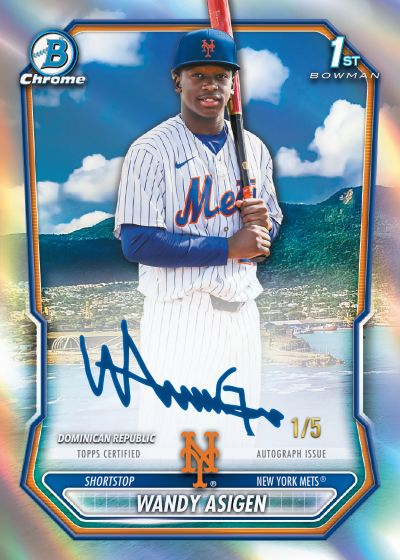
The 66 high matters here. Asigen has enough model upside to remain interesting even without a huge present Performance separation.
34. Wilder Dalis — 3B
45 | 54 | 63 | Performance 56
Single-A experience plus a Performance score modestly above baseline makes Dalis a solid developmental follow.
35. Johenssy Colome — SS
43 | 51 | 60 | Performance 53
Early positive movement, but still squarely in prove-it territory.
36. Ramiro Dominguez — 2B
49 | 56 | 64 | Performance 51
The baseline is stronger than the current production. Dominguez needs the performance to catch back up.
37. Austin Overn — OF
46 | 53 | 62 | Performance 58
A Double-A outfielder performing five points above median deserves attention. He has less developmental runway than the teenagers but substantially more proximity.
38. Dawvris Brito — SS
42 | 48 | 55 | Performance 50
Slightly positive production signal, but not enough separation yet to reshape the profile.
39. Hyun Seung Lee — IF
48 | 56 | 66 | Performance 60
One of the more interesting names in this tier. The 60 Performance score and 66 high give Lee a legitimate path upward.
40. Luis De La Torre — RHP
40 | 45 | 51 | Performance 41
High-A competition provides useful evidence, but the current signal remains below baseline.
41. Jaiden Lo Re — SS
50 | 59 | 68 | Performance 61
A strong sleeper profile: Single-A, 59 median, 68 high and Performance already above the midpoint.
42. Darell Morel — IF
41 | 46 | 53 | Performance 42
Still largely projection-driven. More evidence is needed.
43. Angel Salio — IF
44 | 52 | 61 | Performance 59
This is exactly the type of deeper player worth circling. Performance is seven points above median despite a #43 ranking.
44. Angel De Los Santos — IF
45 | 53 | 62 | Performance 54
Balanced profile with slight positive separation. Worth tracking as the sample develops.
45. Patrick Copen — RHP
39 | 43 | 49 | Performance 37
Double-A matters, but the present performance is pulling in the wrong direction.
46. Romeli Espinosa — IF
37 | 43 | 50 | Performance 35
The model needs considerably more from the current performance before there is a breakout case.
47. Avery Owusu-Asiedu — CF
38 | 42 | 48 | Performance 38
Already at High-A but currently below median. Developmental proximity is the primary reason to continue monitoring.
48. Gregory Pio — OF
43 | 51 | 60 | Performance 55
A deeper DSL name with a genuine positive signal. His 55 Performance score sits four points above the median with a 60 high.
49. Will Watson — RHP
38 | 46 | 54 | Performance 45
The range remains respectable, but Watson is currently on the 7-day injured list, adding another layer of uncertainty.
50. Randy Santana — OF
38 | 44 | 51 | Performance 44
Performance and baseline are aligned. A pure monitor rather than a current breakout.
DEEP CHECKLIST SLEEPERS — RANKS 51–70
51. Yordani Soto — IF
44 | 52 | 61 | Performance 51
A reasonably strong range for this section of the checklist. The performance has not separated yet, but the 61 high keeps Soto relevant.
52. Gustavo Baptista — C
43 | 52 | 61 | Performance 52
Perfect alignment between median and Performance. Catcher development makes him worth following even without a breakout signal.
53. Wilton Guerrero Jr. — SS
41 | 50 | 59 | Performance 53
Performance is beginning to run ahead of baseline. One of the better lower-half DSL names to monitor.
54. Enmanuel Merlo — SS
41 | 49 | 58 | Performance 53
Similar story: four-point performance advantage over median creates a small but meaningful positive signal.
55. Randy Arias — SS
41 | 49 | 58 | Performance 53
Nearly identical model shape to Merlo. The next meaningful separation will likely come from future performance rather than projection.
56. Juan Rojas — SS
41 | 49 | 58 | Performance 51
FCL exposure gives Rojas a slightly different developmental context than the DSL shortstops around him.
57. Stharlin Torres — RHP
36 | 46 | 56 | Performance 51
Five points above median makes Torres one of the better performance-driven pitching sleepers in the lower half.
58. Slater de Brun — OF
36 | 47 | 59 | Performance 51
There is still upside here, but his rehab status is important. The 59 high remains interesting if healthy development resumes.
59. Ricky Duran — SS
39 | 47 | 57 | Performance 52
Another lower-level player with production beginning to outperform the baseline.
60. Ezequiel Melburne — SS
39 | 47 | 56 | Performance 48
Essentially neutral. No major positive or negative divergence yet.
61. Anthony Martinez — 1B
42 | 49 | 58 | Performance 50
The High-A level is notable, but as a first baseman the offensive bar will naturally be higher. The current model signal remains modest.
62. Enyervert Perez — 2B
39 | 46 | 53 | Performance 42
Current performance is below the baseline. Needs a rebound before becoming a serious sleeper.
63. Rubel Arias — OF
38 | 46 | 55 | Performance 48
A small positive gap. Worth filing away rather than prioritizing.
64. Deward Tovar — RF
38 | 45 | 53 | Performance 41
Current production is lagging the median.
65. Sir Jamison Jones — C
37 | 44 | 52 | Performance 37
The catcher designation gives the profile some positional interest, but the performance needs to improve.
66. Fabricio Blanco — SS
33 | 44 | 57 | Performance 46
Blanco is a good example of why the high outcome still matters deep in a checklist. The 57 high is substantially better than his floor, illustrating how uncertain very young DSL profiles can remain.
67. Brendan Jones — CF
33 | 42 | 53 | Performance 49
Already in Double-A and running seven points above median. That makes Jones more interesting than the #67 ranking initially suggests.
68. Edward Duran — C
33 | 43 | 54 | Performance 48
A High-A catcher with Performance ahead of median. Not a premium profile, but a sensible deep follow.
69. Elaineiker Coronado — SS
36 | 45 | 57 | Performance 53
One of the clearer lower-board positive gaps: Performance is eight points ahead of median.
70. Wyatt Vincent — OF
36 | 45 | 55 | Performance 47
Small positive signal with FCL exposure. Development still has a long way to go.
LONGER-TERM FOLLOWS — RANKS 71–90
At this point in the checklist, certainty drops considerably. These are not necessarily players to dismiss. They’re players for whom the model currently has less reason to make an aggressive claim.
71. Garielvin Silverio — OF
34 | 42 | 51 | Performance 43
Performance is essentially aligned with baseline. Also notable: the checklist does not currently mark Silverio as having a 1st Bowman Chrome autograph.
72. Brandon Clarke — RHP
31 | 41 | 58 | Performance 44
The 58 high provides considerably more upside than the ranking suggests, but Clarke’s rehab status increases the uncertainty.
73. Alejandro Nunez — SS
38 | 48 | 59 | Performance 54
One of the better late-list statistical signals. High-A experience and Performance six points over median make him worth remembering.
74. Ariel Roque — OF
34 | 42 | 51 | Performance 42
Performance and median are identical. A developmental follow.
75. Alex Rodriguez — OF
33 | 42 | 51 | Performance 46
Slight positive performance separation, but still an early DSL profile.
76. Logan Sauve — C
36 | 45 | 55 | Performance 50
High-A catcher with Performance ahead of baseline. The checklist does not currently list a 1st Auto.
77. Adrián Lunar — C
33 | 42 | 52 | Performance 45
A young catcher with modest positive performance separation. Plenty of developmental uncertainty remains.
78. Braylen Wimmer — SS
30 | 37 | 44 | Performance 31
Already in Double-A, but the current Performance score is meaningfully below median.
79. Pedro Gomez — OF
30 | 40 | 49 | Performance 39
Almost perfectly aligned with baseline. No major signal yet.
80. Logan Dawson — SS
28 | 37 | 46 | Performance 37
Performance equals median. A true wait-and-see FCL profile.
81. Leonardo Reynoso — IF
31 | 40 | 50 | Performance 42
Small positive performance gap with a 50 high.
82. Randy Guzman — RHP
30 | 39 | 51 | Performance 44
One of the more interesting pitching names this far down the board. Performance is five points ahead of median and the high still reaches 51.
83. Alexandel Pio — SS
28 | 37 | 47 | Performance 34
Current production trails the baseline. More development is needed before there is a real breakout argument.
84. Juan Rujano — C
28 | 39 | 50 | Performance 40
Performance and median are nearly identical. The positional development remains the primary reason to watch.
85. Chris Arroyo — 1B
30 | 42 | 58 | Performance 50
This is one of the widest ranges near the bottom of the checklist, but Arroyo is currently on the 60-day injured list. The 58 high keeps the upside alive; availability keeps certainty very low.
86. Mason Miller — RHP
23 | 31 | 40 | Performance 23
Current production is substantially below baseline. The model does not presently see enough evidence to make an aggressive case.
87. Yunior Amparo — SS
25 | 38 | 54 | Performance 43
A surprisingly wide range for the #87 player. Performance is above median, but injury status and a very low floor illustrate the uncertainty.
88. Erick De La Cruz — OF
24 | 37 | 49 | Performance 42
Five-point positive performance gap. Still a long-range development bet rather than a current priority.
89. Jeancer Custodio — OF
20 | 32 | 43 | Performance 37
Production is ahead of median, but the overall range remains one of the weakest on the current board.
90. Edwin Díaz — SS
Displayed: 20 Low | 13 Median | 30 High | Performance 51
This entry needs to be treated differently.
The displayed Prospect Baseline range is internally inconsistent because the listed Low score of 20 exceeds the listed Median of 13. Díaz also carries a Performance score of 51 while appearing at the bottom of the checklist.
Rather than invent an explanation for inconsistent data, this should be treated as a data-quality exception requiring a future model refresh or correction.
The checklist also does not currently mark Díaz as having a 1st Auto.
Takeaway: No prospect conclusion should be drawn from the displayed range until the underlying entry is corrected.
THE PLAYERS I’M WATCHING MOST
After working through all 90 names, several groups emerge.
Best combination of certainty and upside: Christian Zazueta
The pitcher-risk disclaimer applies, but nobody else on the checklist currently combines Double-A proximity, strikeout production, a strong three-pitch foundation and an 82 model median.
Highest-end position-player profile: Luis Hernández
A 17-year-old shortstop already producing after reaching Single-A, with legitimate offensive and defensive projection, is almost the prototype of what collectors want from Bowman Chrome.
Best statistical breakout: Francisco Renteria
A .366 average, .447 OBP, 1.087 OPS, nine home runs and 20 steals at 17 demands attention. The only reason not to push him dramatically higher immediately is the level.
Most fascinating physical/upside profile: Santiago Solarte
A 6-foot-5, 17-year-old shortstop producing both double-digit home runs and extreme stolen-base totals is inherently unusual. His eventual defensive home and performance outside the DSL will be critical.
Most underrated by ordinal rank: Angeibel Gomez
The #10 beside his name hides a 69 median, 79 high and 75 Performance score. Combine that with his huge DSL production and Gomez has a strong argument as one of the most interesting players in the product.
Sleeper outside the Top 20: Louis Andujar
A 64 median, 79 high and 67 Performance score from a Single-A shortstop at #26 is exactly the type of profile this exercise is designed to uncover.
Another name that shouldn’t be buried: Francisco Espinoza
A catcher with a 64 median, 76 high and 65 Performance score deserves considerably more attention than most #27 prospects on a checklist.
Deep performance sleeper: Elaineiker Coronado
At #69, Coronado’s 53 Performance score is eight points higher than his current 45 median. That’s not enough to declare a breakout, but it is enough to remember the name.
THE BIGGER PICTURE
The most important takeaway from the 2026 Bowman Chrome checklist may be just how international and development-heavy the top of the class currently looks.
After Christian Zazueta, Luis Hernández and Enddy Azocar, the board quickly becomes filled with 17-year-old DSL players.
That creates enormous upside.
It also creates enormous uncertainty.
A player such as Francisco Renteria, Santiago Solarte, Jaider Suárez or Angeibel Gomez can put up a spectacular debut season without yet answering the questions that come with full-season baseball. The jump from dominating rookie competition to handling better velocity, more advanced breaking pitches, longer seasons and stronger defenders is significant.
That is why the model does not simply sort the checklist by OPS.
And it is why some of the most interesting players may actually be names such as Sebastian Dos Santos, Louis Andujar and Francisco Espinoza. They have begun accumulating evidence outside the DSL while still maintaining significant model upside.
There is another important point for collectors.
The biggest hobby name and the best prospect are not always the same player.
Card prices can be driven by signing bonus, prospect-list placement, organization, social attention, scarcity and pre-release hype. Prospect development does not care about any of those things.
The goal of this guide is to separate the two.
The players at the top have earned deeper attention. The sleepers farther down have identifiable reasons to remain on the radar. And the bottom of the list should not be treated as “bad prospects” — it should be treated as an area where the current evidence does not yet justify the same level of confidence.
That distinction becomes especially important in a product built around teenagers.
Today’s #60 prospect can disappear.
Today’s #60 prospect can also be next year’s breakout.
The purpose of Prospect Baseline is to keep measuring which direction the evidence is beginning to point.
Model snapshot: August 11, 2026. Rankings and player ranges are expected to change as the 2026 season continues.