
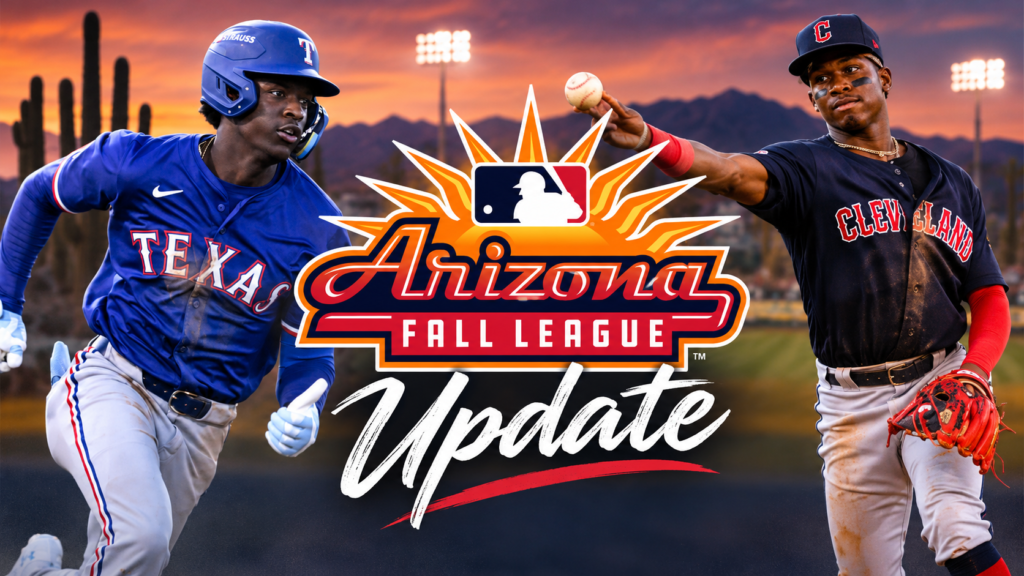
With the Fall Stars Game approaching and the final week of play ahead, several top prospects are making up for lost time in Arizona. Others are giving their organizations a new reason to look closely at their 2027 plans.
Five weeks into the 2026 Arizona Fall League, the biggest names have provided plenty to discuss. Sebastian Walcott is producing some of the hardest contact in the league. Aidan Miller keeps finding his way on base. Arjun Nimmala has followed a rough stretch with one of the best individual games of the fall. Meanwhile, Welbyn Francisca and several less-publicized hitters have climbed the offensive leaderboards.
Our September AFL preview focused on the prospects with the most to gain from extra games. With the season approaching its conclusion, there’s a clearer picture of what they’ve accomplished and where questions remain.
Sebastian Walcott
For Sebastian Walcott, the most encouraging part of the fall has been his return to regular competition. The Rangers shortstop underwent surgery on his right elbow in February and did not return until mid-July. Arizona has provided additional games after a season with limited opportunities to establish a rhythm.
The power has been obvious. Walcott has recorded exit velocities of 113.9 and 113.3 mph, two of the league’s hardest-hit balls. He was batting .316 with an .843 OPS entering play on November 3. Those are useful results, but the bigger question is how often that impact contact appears as his timing improves. His work at shortstop and in the outfield also gives Texas another look at his defensive options.
Aidan Miller
Aidan Miller has made his return from back problems count. The Phillies infielder missed nearly the entire minor league season, then joined Surprise to regain at-bats and get experience at third base.
Miller entered play on November 3 with a .588 on-base percentage, and he remained the AFL’s walks leader heading into Fall Stars weekend. His patience isn’t new. He finished the final 36 games of his 2025 minor league season hitting .356/.491/.607. The current run is encouraging because it follows that earlier success and comes after a long injury absence.
There is still context to consider. AFL pitchers have historically walked hitters at unusually high rates, so the quality of Miller’s swing decisions matters more than the walk total on its own. For Philadelphia, the bigger developments are his health, the return of his approach at the plate and his progress at third base.
Arjun Nimmala
Arjun Nimmala has had a less linear fall. The Angels shortstop went 2-for-24 with 10 strikeouts over seven games, then broke out of the slump with a 5-for-7 performance against Salt River on October 29. He homered, doubled and stole a base that night, pushing his AFL OPS back to .980 at that checkpoint.
That stretch illustrates both sides of his offensive profile. Nimmala has enough power to change a game quickly, but the strikeouts remain worth tracking as he moves toward higher-level pitching. His fall has been productive without settling the question of how consistently he’ll make contact against quality secondary offerings.
Eduardo Quintero
Dodgers outfielder Eduardo Quintero is a useful reminder that the AFL offers information beyond the batting line. MLB’s Fall League Statcast review recorded a 99.0-mph throw from the outfield, an objective measure of the arm strength that adds value to his defensive profile.
Quintero’s offensive development still matters most to his long-term ceiling, but a quieter stretch at the plate does not erase the tools that made him a highly regarded prospect entering Arizona.
Aroon Escobar
The stakes are different for Phillies infielder Aroon Escobar. After hitting .230/.332/.347 with 12 home runs and 27 stolen bases in 132 Double-A games, Escobar entered the fall looking for a stronger finish to a disappointing offensive year. He is also eligible for the Rule 5 Draft this offseason, which makes Philadelphia’s 40-man roster decisions especially relevant.
Through the November 6 games, Escobar had hit .250/.370/.386 in 12 AFL games. He had drawn nine walks in 54 plate appearances, but also struck out 15 times and had yet to homer. The batting line is better than his regular-season mark, although it is hardly the dramatic offensive surge seen elsewhere in Arizona.
There have been flashes of harder contact. Escobar hit a triple recorded at 111.3 mph in early November, demonstrating that he can drive the ball with authority. The question is whether those swings can become more frequent. His 2026 Double-A strikeout rate was just 16.2%, but his slugging percentage was .347. Putting the ball in play was not the problem as much as doing damage with it. With roster decisions ahead, that remains his central offensive issue.
The AFL’s Offensive Environment
Arizona has always required some statistical restraint. Baseball America’s review of the 2025 Fall League found 972 walks in 6,374 batters faced, a 15.2% walk rate, compared with roughly 8.4% in MLB. The 2026 Opening Day group of MLB Pipeline Top 100 prospects also leaned overwhelmingly toward hitters, with 14 position players and one pitcher.
Neither figure tells us that an individual player’s performance is artificial. They explain why a few weeks of batting average or OPS should not outweigh a much longer minor league record. The contact quality, swing decisions and health of the players themselves remain the more useful things to monitor.
Welbyn Francisca and Teo Banks
Welbyn Francisca has been one of the league’s most productive hitters. Through November 6, the Guardians infielder led the AFL with a .419 average, 31 hits, 28 RBIs and a 1.198 OPS. He had also homered four times in 16 games.
Francisca arrived with evidence of progress. He raised his OPS from .622 in 2025 to .879 during the 2026 minor league season, when he hit 19 home runs. His Arizona production builds on that improvement rather than appearing without warning. The next test will be repeating it over a longer stretch against upper-level pitching.
Nationals outfielder Teo Banks offers a different comparison. He posted a .708 OPS in 92 games at High-A Wilmington, then reached 1.064 across 71 AFL plate appearances at a November 1 checkpoint. Early fall reports also documented a 109.5-mph maximum exit velocity. The contact is worth noting, but Banks has less regular-season production behind his surge than Francisca does. That makes his 2027 performance particularly important.
Chase Harlan and Antonio Anderson
Two additional hitters have drawn attention with measurable power. Dodgers third baseman Chase Harlan hit a 451-foot home run at 112.1 mph in October and had reached five AFL homers by November 3. After a strong introduction to pro ball in 2026, the next step is showing how consistently his power plays against better pitching.
Red Sox infielder Antonio Anderson has also supplied evidence of serious raw power. His October 9 grand slam left the bat at 115.2 mph. More recently, he went 5-for-11 with six walks during Week 5, and MLB counted three fall home runs in his first 15 games. Anderson finished the regular season with an .826 OPS at High-A Greenville, giving his Arizona performance a useful point of comparison.
The Final Week
The Fall Stars Game on November 8 brings many of these names into the same showcase, with the AFL championship scheduled for November 14. Walcott, Miller and Nimmala have used the extra games to sharpen skills after very different regular seasons. Francisca, Harlan and Anderson have forced their way into the conversation through production and hard contact. Escobar’s situation is less about a fall leaderboard and more about the offensive progress Philadelphia needs to see before a roster decision.
The results are worth following, but the final week won’t answer every development question. The next full minor league season will offer a better test of which improvements last. For continuing scores, player lines and league coverage, visit the Prospect Baseline Fall and Winter League Tracker.
Statistics reflect the latest cited checkpoints through November 6–7, 2026, with earlier dates specified where applicable. Article prepared November 8, 2026.